7 min read · October 19, 2026
What’s Your Day Master?
Your birth moment holds eight characters. The Day Master is the one Ba Zi treats as you — a starting point for the rest of the chart, not a finished portrait.
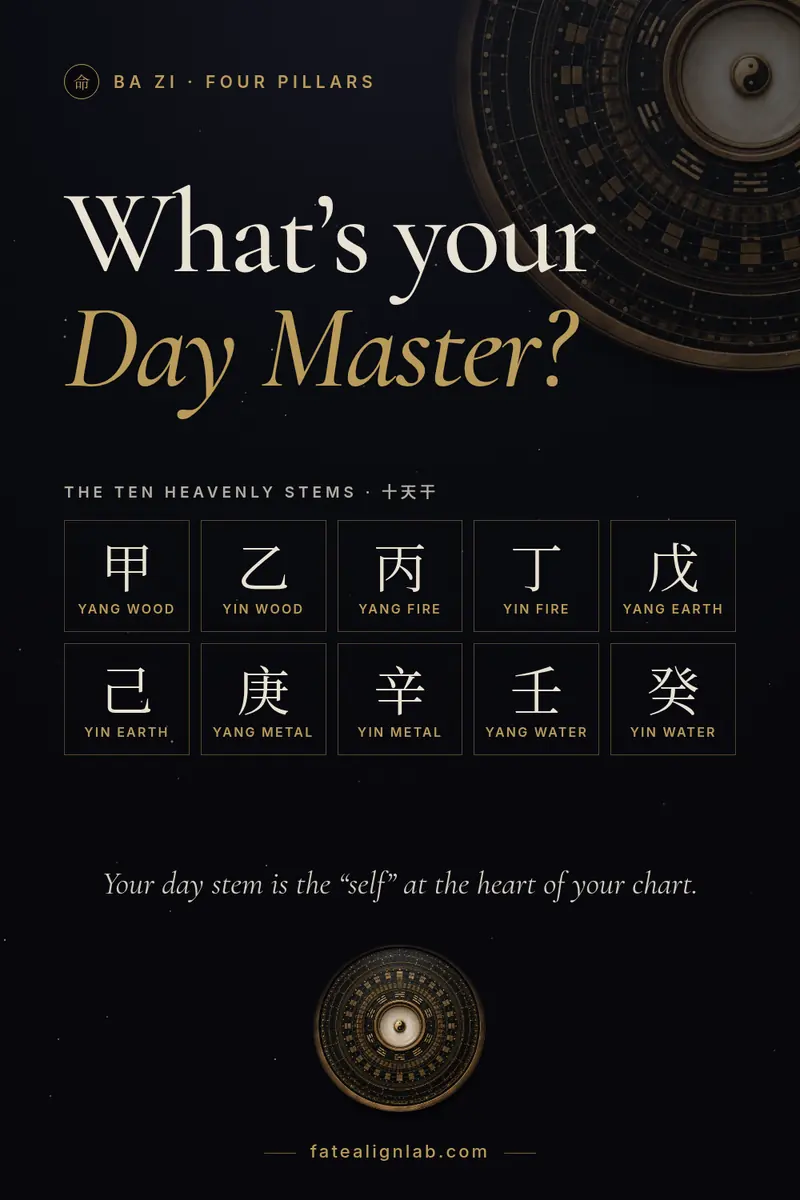
Eight characters, one of them called you
Ba Zi — Four Pillars — writes a birth moment as four pairs. Year, month, day and hour each contribute a heavenly stem and an earthly branch. Eight characters, which is why the older name is the eight characters (八字). The Day Master is the heavenly stem of the day pillar. In the way this tradition is usually taught, that stem stands for the person, and the other seven characters are read by how they sit around it. That is a smaller claim than a personality type. A Day Master tells you which of the ten stems is the center. It does not, by itself, tell you whether that center is comfortable in the chart, what the month is doing to it, or which parts of life the other stems and branches are describing. People sometimes stop at the Day Master because it is the one character that is easy to name. The chart starts there. It does not end there. If you want the character itself, the free Ba Zi chart marks the day stem from your birth date, clock time and city. The same three facts are what a longer reading uses. Nothing on this page will name your stem for you, because a stem without the birth data is a guess.
Ten stems, five elements
The ten heavenly stems are the yin and yang forms of the five elements. Jia and Yi are Wood, Bing and Ding are Fire, Wu and Ji are Earth, Geng and Xin are Metal, Ren and Gui are Water. Jia and Yi share an element and do not share a manner. The images teachers use — a standing tree, a vine — are teaching pictures, not measurements of character. The Day Master’s element is also not “your element” in the loose sense. The chart counts all five from every stem and from the hidden stems inside the branches. This site’s method, on the methodology page, counts a heavenly stem as one, the main hidden stem as one, and the other hidden stems as a half. A Wood Day Master can sit in a chart already full of Wood, or in one where Wood is scarce. The name is the center. The count is what is crowded and what is thin. Season matters as much as the name. The month branch is the season, and skipping it is how a ten-word “you are Wood” line gets ahead of the chart.
What the other characters are doing
Once the Day Master is set, classical reading looks at the relationship between that stem and every other stem and hidden stem. Those relationships are the Ten Gods. The names — resources, companions, output, wealth, authority — are roles relative to you, not job titles and not people who are guaranteed to appear. A wealth star in the chart is a traditional symbol for a kind of relationship to resources. It is not a balance in a bank account, and it is not a promise that money will arrive. This is also why two people with the same Day Master can live very different lives. One may have that stem supported by the month. Another may have it pressed by the season and by the hour. The label on the day is shared. The arrangement is not. When a description of “the Jia Wood person” seems to fit everyone and no one, it is usually because the other seven characters were left out. The hour pillar is the one most often missing from a casual reading, because people remember a birthday and not a birth time. The Day Master usually stays put when the clock moves by an hour. The hour pillar beside it does not. A chart without an hour is a three-pillar sketch. It can still be interesting. It is not the eight characters.
A place to start, not a verdict
Use the Day Master as the handle of the chart. Learn its element, notice whether the month’s season feeds that element or restrains it, and then look at which of the other roles actually show up. If a sentence about your stem feels true, treat that as a question to check against your own memory, not as a fact the calendar proved. If it feels wrong, the rest of the chart is the first place to look — not a reason to force the sentence to fit. Ba Zi is a symbolic language built on calendrical rules. FateAlign Lab calculates those rules and then writes about them in ordinary words. The calculation is fixed for a given birth moment. The wording is an interpretation, and interpretations are for reflection. They are not medical, legal or financial advice, and they do not assign you an outcome. When you are ready to see the stem in place, start with the free chart. It needs no account. If you later want the relationships around that stem written out — career, money, or the ten-year cycles — that is a separate reading of the same chart, not a different person.
Frequently Asked Questions
Is the Day Master the same as a sun sign?
No. A sun sign is the Western tropical sign of the Sun on your birthday. The Day Master is the heavenly stem of the Chinese day pillar. They come from different calendars and answer different questions. A later note on this journal compares the two side by side.
Can my Day Master change if my birth time was recorded wrong?
The day stem changes at the day boundary, not at every two-hour block. An error of an hour usually changes the hour pillar rather than the Day Master. Near midnight, and once true solar time is applied, the day itself can move. That is why the city and the clock both belong in the calculation.
Does a “strong” Day Master mean a lucky life?
No. Strength, in the method this site uses, is a technical description of how much the month and the rest of the chart support the day stem. It is not a score for happiness, success or health.
See your own chart before you decide what any of this means for you. The free Ba Zi chart uses your birth date, time and city.