4 min read · November 3, 2026
Zi Wei Dou Shu Wealth Palace: How to Read Money Themes
Read the stars in your Wealth Palace alongside their transformations. A calculated example shows how to keep money themes grounded in the chart.
Find the Wealth Palace in your own chart
The Wealth Palace in Zi Wei Dou Shu is the part of the chart traditionally read for money and material resources. Its Chinese label is 财帛. Begin with the stars listed there, then check which Four Transformations name the same palace. Open your free Zi Wei Dou Shu chart with your birth date, city and confirmed birth-time window. The result includes a money section before the twelve-palace grid. Read that section with the Wealth Palace in view so you can connect the explanation to its source. If you are still finding your way around the diagram, the twelve-palace guide explains its layout. The Life Palace guide gives a worked example of reading all the stars in a cell together.
A worked example with two different markers
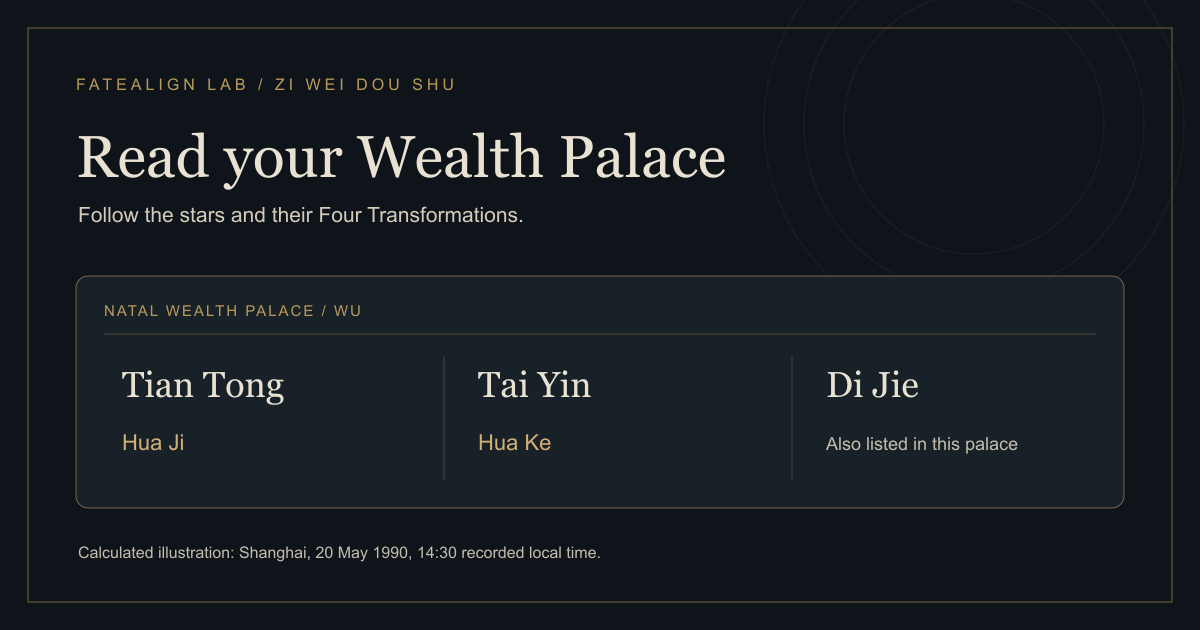
Use the same illustrative profile as the Life Palace guide: male, Shanghai, 20 May 1990, 14:30 recorded local time, solar calendar. The site applies historical clock rules and true solar time correction. The Wealth Palace is Wu (午), with Tian Tong, Tai Yin and Di Jie listed in it. The natal Four Transformations name Tian Tong with Hua Ji in Wealth and Tai Yin with Hua Ke in Wealth. Both entries belong to this example. Reading only one marker would miss part of the arrangement. These are natal entries; a date-specific annual layer would be a separate view. In the free reading’s explanations, Ji draws attention to friction or a repeated concern. Ke draws attention to explanation, recognition and the quality of feedback. Applied here, a useful question is where a money arrangement needs clearer information, and which unresolved detail deserves attention. For instance, if you are comparing an expected payment with a recurring commitment, you could check the written terms before assuming the money will arrive. That is an example of using the reading to frame a question. The placements themselves establish neither your income nor an existing payment problem.
Keep the whole palace in view
The same example also lists Di Jie. A short introduction cannot settle every interaction among the three stars and two transformations. Keep the full group visible when moving to a fuller reading, rather than choosing whichever single label sounds most appealing. An empty Wealth Palace needs the same care. When the free reader finds no major star there, it explains the gap and offers a question to consider. A fuller traditional reading can examine the opposite and related palaces. Borrowed stars should remain identifiable as borrowed. The Career Palace asks about your working role; the Wealth Palace asks a different set of questions about money. Reading both gives you two topics to compare. A demanding role can raise questions about compensation or resources, but that relationship still needs details from your actual circumstances. Our Career Palace guide shows how to make that comparison.
Take one useful question away
Choose one money arrangement you want to understand. It could be an ongoing commitment, shared spending or the terms of a project. Write down what you know from a statement or agreement and what remains uncertain. Then read the relevant palace and transformation explanations. If a theme points to a useful question, make that question specific: which term needs clarifying, which amount needs checking or which responsibility needs agreeing? Keep a theme that helps you examine the arrangement and set aside one that does not fit. This is a traditional symbolic reading, not a financial assessment or an investment recommendation. Decisions about borrowing, saving and investing require your actual finances and appropriate advice. Find your Wealth Palace in the free chart. You can read the money section, inspect the listed stars and review the Four Transformations before choosing whether you want a fuller interpretation.
Frequently Asked Questions
Does a Wealth Palace show how much I will earn?
It presents traditional money themes. It does not calculate income, account balances or investment returns. Use actual financial information for those questions.
Can Hua Ji and Hua Ke both appear in the Wealth Palace?
Yes. In the worked example, Tian Tong carries the natal Hua Ji marker and Tai Yin carries natal Hua Ke in the Wealth Palace. Keep the star, palace and time layer attached to each entry.
Is an empty Wealth Palace missing from the free chart?
A palace without a major star is still part of the chart. The free reader explains that condition instead of inventing a star placement. A fuller interpretation can consider related palaces.
See the twelve palaces and stars in your own chart. Start with your birth date, city and birth-time window.